
Monthly Market Update
After the Market Update, Check These Local Signals
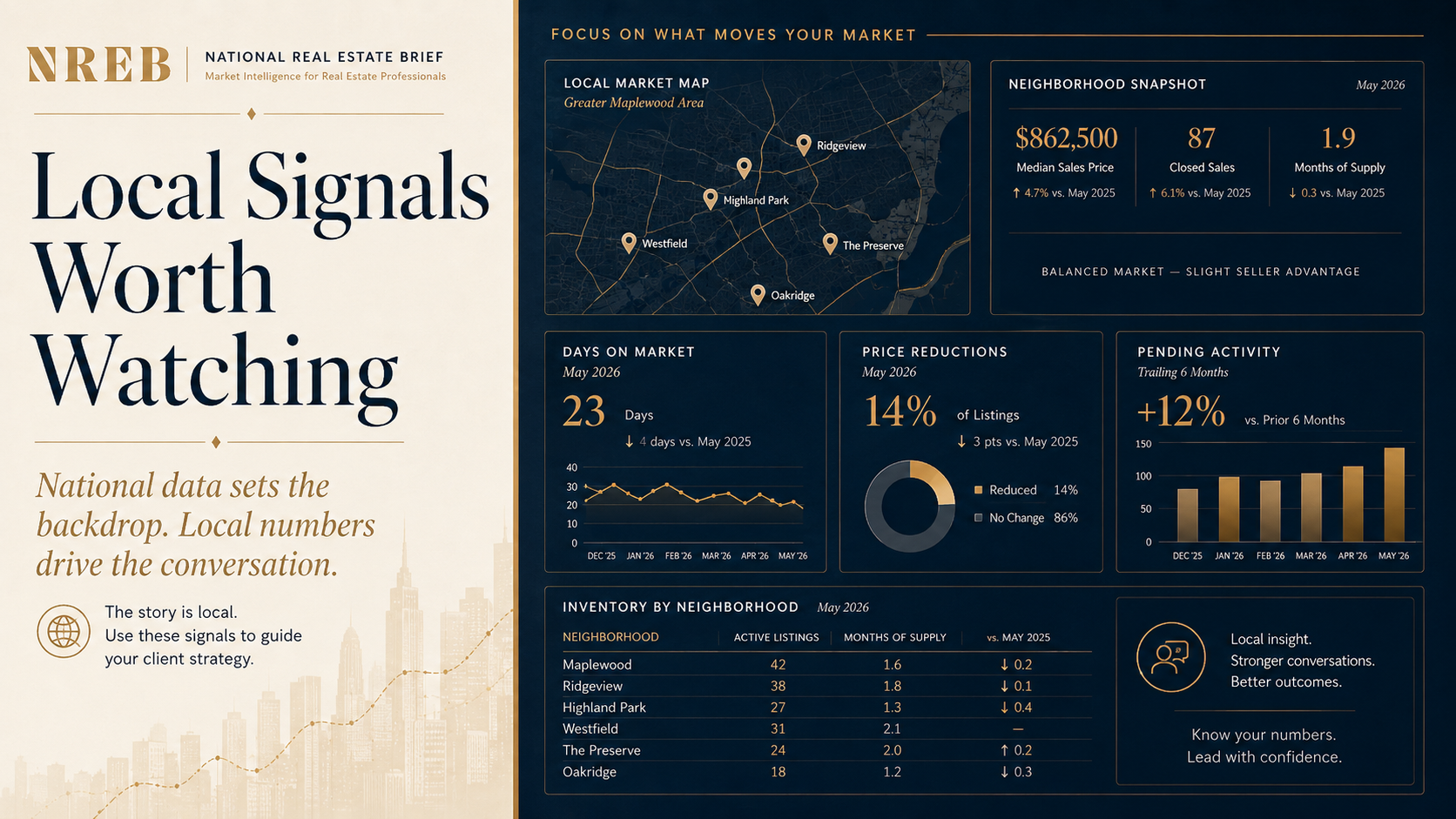
National data gives the backdrop. Local numbers shape the actual client conversation.
In partnership with

Welcome back, NAR members.
Quick Sunday note today.
Yesterday’s NREB May Market Update gave the national picture: more supply, still-elevated rates, selective buyers, and a market that is moving, but not exactly running hot.
Today, we want to make that a little more practical.
Because national data is useful, but your next client conversation is probably not about the national market. It is about their market, their price range, their neighborhood, their payment, and their timing.
So if you only have a few minutes this week, here are the local signals worth checking.

The national market is the backdrop, not the answer
National numbers tell you the direction of the wind, local numbers tell you what is actually happening on the ground.
That distinction matters right now because the market is uneven. Some areas are gaining inventory quickly. Some are still tight. Some sellers are adjusting. Others are still pricing like demand is stronger than it is.
That means the most useful agents are not just repeating national headlines, they are translating them.
When a buyer asks, “Is this a good time to buy?” or a seller asks, “Can we still get our number?” the answer depends heavily on what is happening locally.
Five local signals worth checking this week
1. Active inventory
Start with how many homes are actually available in your market or submarket.
If active inventory is rising, buyers may have more room to compare. If it is still tight, sellers may retain more leverage than the national story suggests.
The key is not just whether inventory is up or down. It is whether the change is meaningful enough to affect behavior.
2. New listings
Active inventory tells you what is sitting. New listings tell you what is entering the market.
A rise in new listings can change the tone quickly, especially if buyers suddenly have several comparable options in the same price band.
For listing agents, this matters because a seller is not just competing against sold comps. They are competing against what launched this week.
3. Price reductions
Price reductions are one of the clearest signals of seller expectation changes.
If reductions are becoming more common, it usually means sellers are discovering that buyers are less forgiving than expected. That does not automatically mean the market is weak, but it does mean pricing conversations need to be more grounded.
This is often where agents can provide the most value: helping sellers understand the difference between aspirational pricing and market-clearing pricing.
4. Days on market
Days on market helps you understand urgency.
If homes are taking longer to move, buyers notice. Sellers may not want to admit it at first, but they usually feel it once showings slow down.
The important part is comparing days on market by property type and price range. A starter home, luxury listing, condo, and investor property may all be telling different stories.
5. Pending activity
Pending sales are where you see whether buyers are actually acting.
Inventory can rise and listings can look better, but if pending activity is soft, demand may still be hesitant. If pending activity is improving, buyers may be adjusting to the current rate environment and re-entering with more confidence.
This is the signal that helps separate “more listings” from “more market movement.”
How to use this with clients
The goal is not to bury clients in data.
The goal is to make the conversation clearer.
For buyers, local data helps answer:
Are we gaining leverage, or just gaining more options?
Are sellers actually negotiating?
Are good homes still moving quickly?
Is waiting likely to help, or just create a different problem later?
For sellers, local data helps answer:
How much competition are we launching against?
Are similar homes reducing prices?
How quickly are buyers acting in this price range?
Do we need to price for attention now, or risk chasing the market later?
That is the practical value of watching local signals. It turns vague market talk into a more specific plan.
And right now, that matters.
Because this is not a market where broad statements are especially useful. “Inventory is up” does not mean every buyer has leverage. “Rates are elevated” does not mean every buyer is gone. “The market is selective” does not mean every listing will sit.
The real answer is usually local.
A quick note for teams and operators
For most agents, the takeaway here is simple: national data gives the backdrop, but local numbers shape the actual client conversation.
And for brokers, teams, or operators trying to turn scattered numbers into something useful faster, the resource below may be worth a look. It’s more operations-focused than our usual market notes, but the core idea fits: better decisions usually start with cleaner reporting.
The ops hire that onboards in 30 seconds.

Viktor is an AI coworker that lives in Slack, right where your team already works.
Message Viktor like a teammate: "pull last quarter's revenue by channel," or "build a dashboard for our board meeting."
Viktor connects to your tools, does the work, and delivers the actual report, spreadsheet, or dashboard. Not a summary. The real thing.
There’s no new software to adopt and no one to train.
Most teams start with one task. Within a week, Viktor is handling half of their ops.
The bottom line
Yesterday’s market update gave the big picture.
This week, the real work is local.
Look at inventory, new listings, price reductions, days on market, and pending activity in the specific markets you serve. That is where the client conversation becomes sharper.
The agents who can explain the national trend and then translate it locally are the ones who will sound the most useful right now.
Not because they have more data.
Because they know what to do with it.