
Monthly Market Update
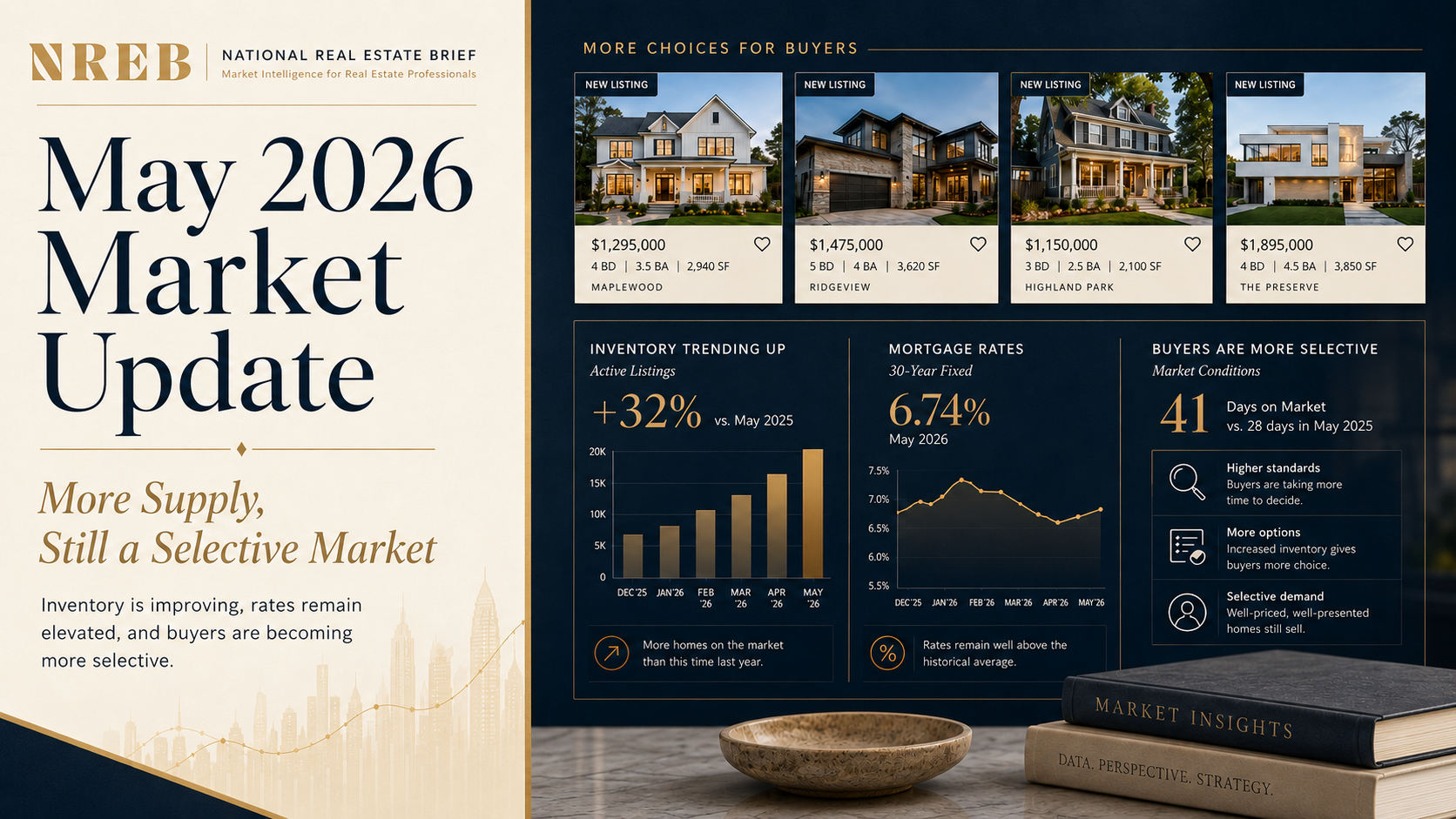
May 2026 Market Update: More Supply, Still a Selective Market
Inventory is improving, rates are still elevated, and buyers are getting more selective.
Welcome back, NAR members.
As always, we’re here to keep you informed while cutting out the fluff. Let’s get right into it.
This is NREB’s May Market Update, one of our most important posts of the month, so it’s a little more detailed than a normal send.
No sponsor today. No product tie-in. Just straight numbers, current market data, and our best read on what those numbers may mean for agents, brokers, investors, and operators heading deeper into spring.
The short version:
The market is not frozen, but it is not running hot either. Supply is improving, buyers are more selective, and pricing strategy matters more than it did a year ago.

The national resale market is still sluggish
The latest national existing-home sales data available from NAR is March. Existing-home sales fell 3.6% month over month to a seasonally adjusted annual rate of 3.98 million, and were down 1.0% from a year earlier. Inventory rose to 1.36 million units, equal to a 4.1-month supply, up from 3.8 months in February. The median existing-home sales price reached $408,800, up 1.4% year over year.
That is not a collapse, but it is also not a broad rebound.
The important detail is that sales softened even as inventory improved. That tells us buyers are not simply waiting for “more options.” They are still constrained by affordability, confidence, financing, and price expectations.
For agents, that matters because it changes the tone of the client conversation. More listings do not automatically mean easier transactions. It means buyers have more to compare, sellers have more competition, and weak pricing or weak presentation gets exposed faster.
Pending sales show demand is still there
Pending home sales increased 1.5% in March from the prior month, though they were still down 1.1% year over year. NAR noted that contract signings rose despite higher mortgage rates, which points to some level of pent-up demand still sitting underneath the market.
That is one of the more important signals right now.
Demand has not disappeared. It has become more conditional.
Buyers will still act when the home, price, payment, and timing make sense. But they are less willing to stretch blindly, and they are much quicker to compare alternatives. That means the agents who can explain value clearly are in a better position than those relying only on broad market momentum.
This is especially true in conversations with hesitant buyers. The question is no longer just, “Do you like the house?” It is also:
Does the payment work?
How does this compare to other options?
Is the seller realistic?
Is the property priced for today’s market or last year’s expectations?
That is where a lot of deals are being won or lost.
April listing data points to a more buyer-friendly spring
Realtor.com’s April housing report showed a continuation of the more buyer-friendly trend. Inventory rose 4.6% year over year, list prices fell for the sixth straight month compared with the prior year, and time on market ticked higher. Realtor.com also reported that 11 of the top 50 metros were buyer’s markets heading into spring, up from eight the prior month.
The strongest takeaway there is not simply “inventory is up.”
It is that sellers appear to be adjusting earlier.
Realtor.com noted that lower list prices and fewer price cuts suggest sellers may be setting more realistic expectations upfront rather than testing high and cutting later. That is a subtle but important shift.
For listing agents, this is where the strategy changes. A seller who insists on “trying a number” may still get showings, but the risk is losing the first wave of attention. In a market where buyers are comparing more and moving slower, the first two weeks matter a lot.
The better conversation may be:
“We do not need to underprice. But we do need to launch where buyers can justify the value immediately.”
That is different from panic pricing. It is disciplined pricing.
Mortgage rates are still the swing factor
Mortgage rates remain one of the biggest constraints on the market. Freddie Mac reported that the 30-year fixed-rate mortgage averaged 6.37% as of May 7, up from 6.30% the week before, but still below 6.76% a year earlier. Freddie Mac also pointed to slightly better buyer conditions from higher inventory, lower new-home prices, and stronger new-home sales.
That is the frustrating part of this market.
Conditions are improving in some ways, but not enough to erase the payment problem.
A small rate move can still change affordability quickly. For buyers already near their comfort limit, even a modest increase can shift the conversation from “we’re ready” to “let’s wait.” For sellers, that means the buyer pool is still sensitive, and pricing needs to account for payment reality, not just comparable sales.
The market is not only about price anymore. It is about monthly cost.
Agents who can explain that clearly will have better conversations with both sides.
New construction is sending a different message
The new-home market is showing a different kind of adjustment. New single-family home sales rose 7.4% in March to a seasonally adjusted annual rate of 682,000, up 3.3% year over year. Inventory stood at 481,000 new homes, or 8.5 months of supply, while the median new-home sales price fell to $387,400, down 6.2% from a year earlier.
That is meaningful.
Builders have more room to adjust than many resale sellers. They can use price reductions, incentives, rate buydowns, closing-cost assistance, and inventory management in ways individual homeowners often cannot. That is one reason new construction can pull demand even when the resale market feels slower.
For agents, this matters because new construction is not just “another option.” In some markets, it is direct competition for resale listings.
If a buyer can get a newer home, builder incentives, and a more attractive financing package, the resale home has to compete more carefully. That does not mean resale loses. It means resale has to be positioned better.
Condition, pricing, location, and seller flexibility all matter more when builders are actively trying to move inventory.
Builders are still cautious
Even with stronger new-home sales, builder sentiment weakened in April. The NAHB/Wells Fargo Housing Market Index fell four points to 34, its lowest level since September 2025. NAHB cited elevated interest rates, economic uncertainty, and buyer affordability concerns as key pressures.
That tells us builders are not acting like the market is suddenly easy.
They are selling homes, but they are still dealing with buyer resistance, financing sensitivity, and cost pressure. That is another reason the broader market feels uneven. Some pockets are moving. Some are softening. Some buyers are active. Others are still waiting.
This is not a uniform national market.
It is a market where local conditions matter a lot.
What this means for agents in May
The main message for May is not “good market” or “bad market.”
It is selective market.
For listing agents, this means seller expectations need to be managed early. The best listings are still moving, but the margin for weak pricing is smaller. If a home is overpriced, poorly presented, or positioned like every other listing online, buyers have more reason to pause.
For buyer agents, this is a moment to show value through context. Buyers may have more leverage than they did during the tightest parts of the market, but that does not mean they can assume every seller is desperate. The opportunity is in helping them identify where leverage is real and where it is imaginary.
For brokers and team leaders, the coaching point is clear: agents need to get better at explaining data. Not overwhelming clients with statistics, but translating inventory, rates, pricing, and days on market into practical advice.
For investors and property managers, the story is more mixed. Better supply and lower new-home pricing may create more opportunities, but financing costs still matter. A deal that looked good at one rate may look very different at another.
The direction from here
The market appears to be moving toward more balance, but not evenly and not quickly.
More inventory is helping. More realistic seller pricing is helping. New construction is offering some relief. But elevated rates are still the ceiling on how much demand can break loose.
So the most likely near-term path is not a dramatic surge or a dramatic collapse. It is a more competitive, more selective spring and early summer market where execution matters.
That means:
pricing has to be sharper
listing presentation has to be stronger
buyer guidance has to be more specific
seller conversations need to happen earlier
and local data matters more than broad national headlines
The agents who do well in this kind of market are usually not the ones pretending everything is great or everything is terrible.
They are the ones who can calmly explain what is actually changing.
The bottom line
May is shaping up as a market with more options, more comparison, and more pressure on strategy.
Buyers are still there, but they are more careful. Sellers still have equity, but they are facing more competition. Builders are still selling, but they are cautious. Rates are lower than a year ago, but still high enough to keep affordability tight.
That is the market.
Not frozen.
Not easy.
Not one-size-fits-all.
Just more selective.
And in a selective market, the agents who can price well, explain clearly, and guide clients through the numbers are the ones who become most valuable.