
Wellput
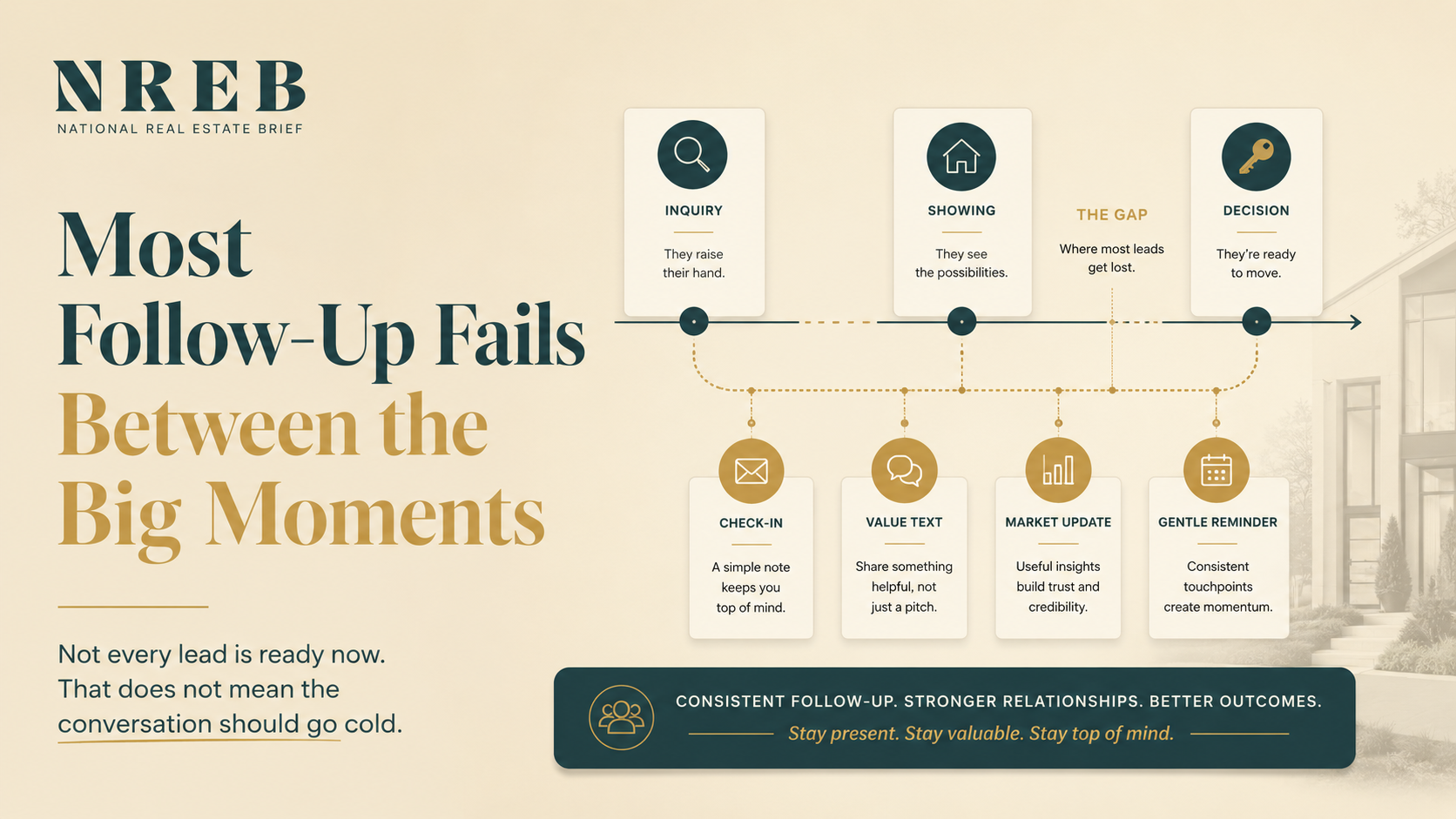
Most Follow-Up Fails Between the Big Moments
Not every lead is ready now. That does not mean the conversation should go cold.
Good morning, NREB readers.
As always, we’re here to keep real estate professionals informed while cutting out the fluff. Let’s get right into it.
Quick Notice: NREB Premium is coming in July
We’re preparing NREB Premium for readers who want the deeper version of NREB once a week: client-ready market intelligence, sharper talking points, and practical guidance before the next week starts.
The free NREB newsletter is not changing. Sample Premium briefings are coming this month so you can see the format before launch.
Reserve Founding Access Here
No card required. Free to reserve access.
Most Follow-Up Fails Between the Big Moments
A lot of real estate follow-up is built around obvious moments.
A new lead comes in.
A buyer tours a home.
A seller asks for a valuation.
Someone walks into an open house.
A past client asks a question.
Those moments are easy to notice because they create immediate activity. There is a reason to respond, a reason to call, a reason to send the next message.
The harder part is everything that happens after that.
That is where a lot of follow-up quietly breaks down.
Not because agents do not care. Usually, it is because the client is not ready yet, and the relationship moves into that awkward middle space where nothing urgent is happening, but the connection still matters.
If you want to get more consistent with that middle space, it may be worth looking at how to build a simple follow-up system that keeps working in the background.

The middle is where people drift
Most people do not move from “interested” to “ready” in one clean step.
A buyer may spend months watching the market before making a serious move. A seller may ask for pricing advice in June and not list until fall. A past client may be happy with you, but still needs occasional reminders that you are active, informed, and worth referring.
That is why the follow-up after the first conversation matters so much.
The goal is not to pressure people every week. That usually does more harm than good. The goal is to stay useful enough that when the timing changes, you are still the person they think of.
That requires a different kind of communication.
Less “Are you ready yet?”
More “Here is something worth knowing.”
What useful follow-up actually looks like
For agents, useful follow-up does not need to be complicated. It just needs to match where the client is in the process.
A new buyer lead may need a simple explanation of payments, inventory, and what to watch before touring. A seller who is months away may need a prep checklist, pricing context, or a reminder about local competition. A past client may appreciate a short homeowner note, market update, tax reminder, or referral-friendly check-in.
The strongest follow-up usually does three things:
gives the person something useful
arrives at a reasonable time
does not make every message feel like a sales pitch
That last part matters. People can tell when communication is only there to extract a transaction. But they also notice when someone keeps showing up with useful information before they need anything.
That is how trust gets built slowly.
Win back time with marketing automation tools from Constant Contact.

You can’t be everywhere at once — but your marketing can.
With Constant Contact’s automation tools, your emails, texts, and offers go out at the right time, every time — without you having to lift a finger.
Want to show your customers you care about them? Use an automaton template to send birthday messages. Working on driving sales? Set up an abandoned cart email automation to gently urge almost-shoppers to become actual shoppers. Looking to bring lapsed customers back into the fold? Send automations with offers and promos to entice them to buy again. You can even create custom automation paths that work best for your business.
It couldn’t be easier. Just set up automatic triggered messages based on your customers’ behavior, and watch those messages run while you focus on everything else.
If you’re ready to save time and put pesky administrative tasks on autopilot, give Constant Contact’s marketing automation tools a try.
Automation should not make you sound automated
This is the part agents need to be careful with.
Automated follow-up is useful when it helps the right message go out at the right time. It becomes a problem when every message sounds like a generic drip campaign that could have come from anyone.
The best version still feels like you.
That means the automation handles timing and consistency, but your judgment still shapes the message. Your market knowledge, your tone, your client experience, and your understanding of what people actually need should still come through.
A good automation path might look simple:
new buyer inquiry gets a helpful first-step email
open house attendee gets a recap and next-step note
seller lead gets a prep timeline
past client gets occasional homeowner value
inactive lead gets a useful market check-in instead of a pushy “just following up”
None of that replaces a real conversation. It just makes sure the relationship does not go silent between conversations.
For agents who already have a list but do not use it consistently, this is where email and text automation can help keep the relationship warm.
The mistake is waiting until someone is ready
If you only communicate when someone is ready to transact, you are showing up late.
By that point, they may have already been influenced by another agent, another market update, another conversation, or another piece of content that helped them feel more confident.
That does not mean you need to overwhelm people. It means the quiet months matter.
The seller who is not ready today may still be paying attention. The buyer who paused because of rates may still be watching. The past client who has not called in two years may still refer you if you remain present in a useful way.
That is the practical value of a good follow-up system.
It keeps the relationship from depending entirely on memory.
A simple place to start
If automation feels overwhelming, do not start with ten different campaigns.
Start with one.
Pick one group of people who should be hearing from you more consistently, then build a simple path around them. Maybe it is new buyer leads. Maybe it is seller valuation requests. Maybe it is past clients. Maybe it is open house attendees.
Then ask:
What would be genuinely useful for this person to receive next?
That question keeps the system from becoming spammy.
If the message is useful, timed well, and written in your voice, automation can support the relationship instead of weakening it.
You can try Constant Contact’s automation tools here if you want a place to start.
The bottom line
Most follow-up does not fail in the dramatic moments.
It fails in the quiet middle.
The client is interested, but not ready. The seller is thinking, but not acting. The past client is happy, but not hearing from you. The lead is warm, but the conversation slowly cools off.
That is where consistency matters.
Not constant pressure. Not generic blasts. Just useful communication that shows up at the right time and keeps the relationship alive until the next real conversation happens.
For agents, that can be the difference between being remembered and being replaced.
NREB Premium Founding Access
Because so many readers have asked for a deeper weekend edition, we’re building NREB Premium for real estate professionals who want more than headlines once a week.
Each Saturday Premium briefing will be designed to help agents, brokers, investors, and real estate professionals turn market shifts, client questions, pricing pressure, buyer hesitation, seller expectations, and business strategy into clearer talking points and practical next steps.
What Premium will include:
One weekly Saturday premium briefing
Client-ready market talking points
Buyer and seller conversation guidance
Pricing, follow-up, and objection-handling angles
Practical scripts, templates, and business-use examples
Premium-only topic voting
A sharper read on the market before the next week starts
The free NREB newsletter is not changing. Premium is simply an optional deeper edition for readers who want more practical market intelligence in one place.
Founding access will open in July. Readers who reserve now will receive their private activation link shortly before launch. No card or payment is required to reserve your spot. Just click to reserve and we’ll know to send your activation link before Premium opens.
Founder pricing will only be available during the founding access window, and NREB Premium will be capped at 10,000 total members to keep the edition focused, high-signal, and built for serious readers.
Founding details:
Reserve now with no card required
Founder pricing: $7.99/month or $79.99/year
Founder pricing stays active for as long as your subscription remains active
Regular pricing after the founding window begins at $9.99/month
NREB Premium will be capped at 10,000 total members
Sample Premium briefings will be shared this month before launch
Reserve Founding Access Here
No card required. Free to reserve access.