
Useful Information
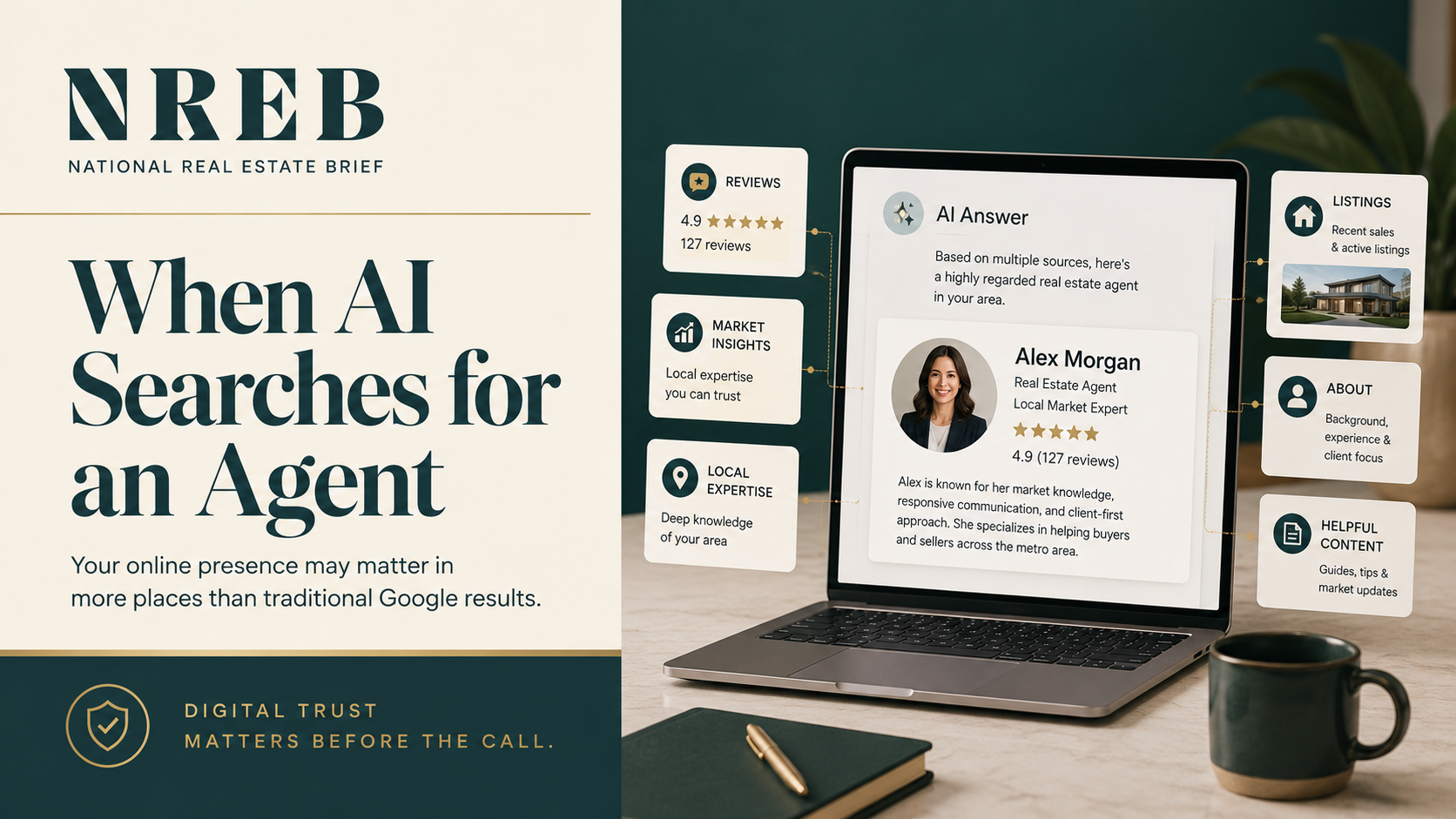
When AI Searches for an Agent
Your online presence may matter in more places than traditional Google results.
In partnership with

Quick Notice: NREB Premium is coming in July
After strong reader demand, we’re launching NREB Premium: a weekly Saturday briefing with deeper, client-ready market intelligence for real estate professionals who want sharper talking points and a better read on what matters.
The free NREB newsletter is not changing. We’ll share sample Premium briefings this month before launch. You may see notices like this while we prepare for launch.
Reserve Founding Access Here
No card required. Free to reserve access.
Good morning, NREB readers.
As always, we’re here to keep real estate professionals informed while cutting out the fluff. Let’s get right into it.
When AI Searches for an Agent
For years, the basic online advice for agents was pretty simple.
Show up on Google.
Have a decent website.
Keep your reviews in good shape.
Make sure people can find your phone number.
That still matters.
But the way people search is starting to feel less linear.
A buyer may still type “real estate agent near me” into Google. A seller may still ask a friend for a referral. Someone relocating may still skim websites, reviews, Zillow profiles, social media pages, and local search results.
But now, some people are also asking AI tools more complete questions.
“Who are the best listing agents in this area?”
“What should I look for in a buyer’s agent?”
“Which real estate agents specialize in this neighborhood?”
“What are the top things to know before selling in this market?”
That does not mean AI has replaced referrals, relationships, or Google.
It does mean your online presence may matter in more places than it used to.

Search is becoming more about signals
The important thing to understand is that AI tools do not magically know who deserves to be recommended.
They rely on signals.
Your website. Your service areas. Your reviews. Your content. Your business profiles. Your local pages. Your name consistency. Your brokerage information. Your public expertise. The way other websites mention or link to you.
All of that helps the internet understand what you do, where you do it, and who you help.
That matters because a generic online presence is easy to overlook.
If your website says the same thing every other agent’s website says, if your service area is unclear, if your bio is thin, if your reviews are scattered, or if your local expertise is not visible anywhere, there is not much for search tools, AI tools, or potential clients to work with.
The goal is not to trick an algorithm.
The goal is to make your real expertise easier to find, understand, and trust.
For agents and small business owners who know SEO matters but do not want it turning into another manual project, today’s sponsor fits this conversation.
What if ChatGPT recommends your competitor first?

Over 2,500 businesses already show up in ChatGPT, Perplexity, and Google. AutoSEO writes expert articles and earns backlinks while they sleep. No SEO learning curve. No agency. Set it up once and let it run.
What agents should make clear online
A strong online presence does not need to be complicated. It needs to answer the questions a real person would have before reaching out.
At minimum, your website and public profiles should make a few things clear:
Who you help
Where you work
What types of clients you serve
What kinds of properties or transactions you understand
Why someone should trust you
What the next step is
That sounds basic, but a lot of agent websites do not do it well.
Some are too generic. Some are outdated. Some are built around broad slogans instead of useful information. Some rely on stock copy that could apply to any agent in any market. Some have no clear local pages, no recent content, no real explanation of how the agent works, and no obvious reason for a client to keep reading.
That is a missed opportunity.
If you work heavily with first-time buyers, say that clearly. If you specialize in move-up sellers, relocation clients, investors, luxury listings, probate, new construction, condos, or a specific neighborhood, make that visible.
Search tools and clients both need clarity.
Local content still matters
For real estate, local content is especially important.
Not because every agent needs to become a full-time blogger. Most do not.
But because local expertise is one of the few things that actually separates one agent from another.
A useful neighborhood page, a market note, a seller guide for a specific area, a buyer FAQ, a relocation overview, or a short explanation of local pricing trends can all help show that you understand the market beyond generic talking points.
Good local content does not need to be long or fancy.
It just needs to be specific.
For example:
What should sellers in this neighborhood know before listing?
What do buyers often misunderstand about this part of town?
How do property types differ from one area to another?
What local costs should buyers consider?
How does new construction compete with resale in your market?
What questions do clients ask you over and over again?
Those are useful topics because they come from real conversations.
That kind of content helps humans. It also gives search systems more context about your expertise.
Reviews and consistency still count
Content is only one part of the picture.
Reviews matter too.
A client may not read every review, but they often scan enough to get a feel for whether you are responsive, knowledgeable, calm under pressure, and easy to work with.
Consistency matters as well. Your name, phone number, website, brokerage, service area, and business information should not be slightly different everywhere someone finds you.
Small inconsistencies may not seem like a big deal, but they create friction.
If a client has to wonder whether they found the right person, that is already a weaker first impression.
The same applies to stale profiles. If your website, Google Business Profile, social pages, or agent profiles look abandoned, people may quietly wonder whether you are still active.
Most will not tell you that.
They will just move on.
The mistake is treating SEO like a side quest
A lot of agents think about SEO as something separate from the business.
Something technical. Something for marketers. Something to deal with later.
But at its core, SEO is really about whether people can find and understand you when they are already looking for help.
That makes it very relevant to real estate.
If a seller is researching agents before calling, your online presence is part of the interview. If a buyer is comparing agents after a referral, your online footprint helps confirm or weaken the recommendation. If someone asks an AI tool or search engine for local guidance, your public signals help shape whether you are part of the answer.
Again, this does not replace relationships.
A strong referral is still powerful. A good reputation still matters. Personal connection still matters.
But today, even referrals often get checked online before the next step happens.
That means your online presence should support the trust you are already trying to build.
The bottom line
Real estate is still a relationship business.
But relationships often start, continue, or get validated online.
That used to mostly mean Google search, your website, your reviews, and your social profiles. Now it may also include AI-driven summaries, recommendations, and search experiences that depend on the same underlying signals.
The practical takeaway is simple:
Make it easier for people, search engines, and AI tools to understand who you are, where you work, and why you are credible.
Not with hype.
Not with keyword stuffing.
Not with generic content.
With clear, specific, useful information that reflects the real work you do in your market.
That is good for SEO.
It is also good for trust.
NREB Premium Founding Access - For Those Interested:
Because so many readers have asked for a deeper weekend edition, we’re building NREB Premium for real estate professionals who want more than headlines once a week.
Each Saturday Premium briefing will be designed to help agents, brokers, investors, and real estate professionals turn market shifts, client questions, pricing pressure, buyer hesitation, seller expectations, and business strategy into clearer talking points and practical next steps.
What Premium will include:
Once weekly Saturday premium briefings
Client-ready market talking points
Buyer and seller conversation guidance
Pricing, follow-up, and objection-handling angles
Practical scripts, templates, and business-use examples
Premium-only topic voting
A sharper read on the market before the next week/month starts
The free NREB newsletter is not changing. Premium is simply an optional deeper edition for readers who want more practical market intelligence in one place.
Founding access will open in July. Readers who reserve now will receive their private activation link shortly before launch. No card or payment is required to reserve your spot. Just click to reserve and we’ll know to send your activation link before Premium opens.
Founder pricing will only be available during the founding access window, and NREB Premium will be capped at 10,000 total members to keep the edition focused, high-signal, and built for serious readers.
Founding details:
Reserve now with no card required
Founder pricing: $7.99/month or $79.99/year
Founder pricing stays active for as long as your subscription remains active
Regular pricing after the founding window begins at $9.99/month
NREB Premium will be capped at 10,000 total members
Sample Premium briefings will be shared this month before launch
Reserve Founding Access Here
No card required. Free to reserve access.